
The Games and Olympic spirit
The Olympic Games are a four-year sporting event that involves the competition among the best athletes in the world in almost all sports disciplines practiced on the five continents. They, although commonly called Olympics, are not to be confused with the Olympiad. The latter indicates the four-year interval between an Olympic Games and the next. For this reason, even though the 1916, 1940 and 1944 games were not played, it continued to count the Olympics, so that the 2004 Athens Games were those of the Ventotesima Olimpiade.
The name Olympic Games was chosen to remember the games that took place in ancient Greece at the city of Olimpia, where the best Greek athletes were confronted. Baron Pierre De Coubertin at the end of the 19th century had the idea to organize games similar to those of ancient Greece, and therefore precluded to female sex, but on this point he was not listened. The first Olympiad of the modern era took place in Athens in 1896. Since 1924, winter Olympic Games specific to winter sports were also established.
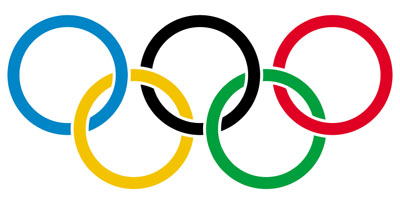
Since 1994 the winter edition is no longer held in the same year of the summer edition, but two years old. The Olympic flag depicts five woven rings in the white field. The colours chosen are present in the flags of all nations, so their combination symbolizes all countries, while the ring intertwine represents the universality of the Olympic spirit. As the same CIO states, it is wrong to believe that the colour of each circle is a certain continent.
Roots in ancient Greece
The motto of the Olympic games is Citius, altius, forteus, or "More fast, taller, stronger" The origin of ancient Olympic games has lost, even though there are many legends about their origins. The first written recording of the celebration of the games in Olimpia is 776 B.C., although this was certainly not the first occasion when they were held. For the accuracy the Games were Agoni, a word that has the same root of agony, and which means effort, competition. The Games were essentially a local event, and initially only one race was played, the stadium.
Later, other sports were added to the race and the Games came to understand the following competitions:
- Race
- Publisher
- Fight
- Pancracy
- Equestrian cats (Carri and Horse Racing)
- Pentathlon (Stop in Long, Yellow Launch, Running, Disk Launch, Fight)
From that moment on, the Games slowly became more important throughout ancient Greece, reaching the peak in the VI and the 5th century BC. The Olympics also had religious importance, as they were held in honor of Zeus, of which a huge statue was in Olympia. The number of races grew to twenty, and the celebrations extended over several days. The winners of the races were admired and immortalized in poems and statues. The Games were held every four years and the period between the two celebrations became known as Olimpiade.
Throughout the duration of the games wars were suspended throughout Greece: this truce was called Ekecheiria. The Greeks used the Olympics as one of their methods to count years. Participation was reserved for free Greeks who could boast Greek ancestors. The need to devote a lot of time to training meant that only the members of the most wealthy classes could consider participating. The prize for these games was only symbolic, consisting of a braided branch of the crown, with which the winner was hired.
But victory had a huge value for the athlete who, back home, was treated as a hero and could cover important charges in the social life of the city State of belonging. To understand the importance attached to this, just think that during games wars were also suspended with the so-called “Sacred Truce”. Four were the great games that took place (not only in the Ellade, but in all neighboring regions and colonies).
The four big games were distinct in: OLIMPICI (dedicated to Zeus/Giove); PITICI or DELFICI (dedicated to Apollo); NEMEI (dedicated to Zeus/Giove); ISTMICI (dedicated to Poseidon/Neptune). The Games gradually lost importance with the increase of Roman power in Greece. When Christianity became the official religion of the Roman Empire, the Olympic Games were seen as a "pagan" party, and in 393, Emperor Theodosius I forbid them, ending a 1000-year history. From the Olympic games of antiquity women were completely excluded. However, the Olympic Games did not die.
The modern revival
In the 17th century, a sports festival named after the Olympics was held in England. In the following centuries similar events were organized in France and Greece, but it was small-scale demonstrations and certainly not international. The interest in the revival of the Olympic Games grew when the ruins of the ancient Olympia were discovered by German archaeologists in the mid-19th century. At the same time a French Baron, Pierre de Coubertin, sought an explanation for French defeat in the Franco-Prussian War (1870-1871).
He concluded that the French had not received adequate physical education, and was committed to improving it. De Coubertin also wanted to find a way of approaching nations, to allow young people in the world to confront themselves in a sports competition rather than at war. And the rebirth of the Olympic Games would have allowed us to achieve both goals. De Coubertin presented his ideas in June 1894 during a congress at the University of Sorbonne in Paris.
On June 23, the last day of the congress, it was decided that the first Olympic Games in the modern era would take place in 1896 in Athens, Greece, where they were born in antiquity. The International Olympic Committee (CIO) was founded to organize the event, under the chairmanship of the Greek Demetrius Vikelas. The first modern Olympics were a success. With almost 250 participants, it was for the time the largest international sporting event ever organized.
Greece asked to become a permanent seat of all the future Olympic Games, but the CIO decided that the Olympics should be organized from time to time in a different nation. The second Olympics were assigned to Paris, France. After the success of the initial edition, the Olympics went through a period of crisis. The two editions of 1900 in Paris and 1904 in Saint Louis were organized as a simple corollary to the Universal Expositions held during those years in the two cities. Concurrent with such an important event greatly limited the resonance of the Olympic event.
Especially in the 1904 edition, international participation was very reduced, to the point that about 80% of athletes were American. In 1906, to celebrate the 10th anniversary of the first modern Olympiad, the IOC organized the Summer Olympics in Athens. There was wide international participation, and great interest in the public. Although they are still not recognized in the official history of the Olympic Games, the 1906 Games helped to increase the popularity of the Olympics. Contrary to the hopes of Baron De Coubertin, the Olympics did not prevent wars.
The Games in twentieth-century history
The Games of 1916 were erased because of the outbreak of World War I, and the same was for the games of 1940 and 1944, due to World War II. In addition, World War I winners prevented the defeated nations from participating in the 1920 Olympic Games. Since 1992 the IOC on the occasion of each Olympiad officially asks the international community (with the support of the UN) to observe the Olympic Truce. Politics intervened on the Olympics also on other occasions.
The 1936 Summer Olympics in Berlin were used as a propaganda tool by the German Nazi Party. A lesser-scale political incident occurred during the celebrations of Mexico City games 1968. Two African American athletes from the light athletics team, Tommie Smith and John Carlos, during the performance of the American anthem at the 200-metre award ceremony, greeted the Black Panthers to denounce racism against African Americans in the USA. In the 1970s and 1980s, however, they were boycotting the Games.
First, the African countries were boycotting the 1976 Olympics to protest against South Africa's tour in full apartheid regime of the New Zealand rugby national. In the Moscow Games in 1980, the U.S., along with other Western bloc countries, refused to participate due to the Soviet invasion of Afghanistan. By reaction, the Soviets and their partners of the Eastern bloc boycotted the subsequent Los Angeles Games in 1984.
One of the most black chapters in Olympic history was written in 1972, at the Munich Olympic Games, in what will pass to history as the massacre of Monaco. A commando of Palestinian terrorists took hostage 11 members of the Israeli Olympic team. The attempt to liberate the law enforcement forces ended in a bloodbath: all athletes, five terrorists and one policeman died. During the 1996 Atlanta Olympics, a bomb placed in Centennial Olympic Park killed two people and wounded more than one hundred.
The bomb was put by Eric Robert Rudolph, who was a Christian extremist. The Salt Lake City 2002 Winter Olympics were the first after the attacks of 11-09-2001. From this Olympiad onwards the Games will require a very high safety standard. The International Olympic Committee (in English) was founded on 23-06-1894 by the French Baron Pierre de Coubertin, and is the highest authority of the Olympic Movement. Its role is to promote sport, even of high levels, only as sports, for everyone, and without distinction.
The movement and its symbols
It also guarantees the regular organization of the Olympic Games, and strongly encourages the promotion of women's sports, sports ethics, and clean sport, without doping. The rules and guidelines under which the CIO operates are outlined in the Olympic Statute. The Olympic movement uses different symbols, mainly inspired by the ideas and ideals expressed by De Coubertin. Probably the most famous symbol are the five circles of the Olympic flag, which is set up at each edition of the Games since 1920. It depicts five rings, of different colour, interlaced in the white field.
The rings are five as the continents: Europe, Asia, Africa, America and Oceania. The rings are the universality of the Olympic spirit. The colors chosen for the five circles are blue, yellow, black, green and red. Along with the white background, these colors were present in flags of all nations of the world at the time they were chosen. The combination of colors therefore symbolizes all countries, while it is to blur the common belief that the color of each circle is to represent a certain continent.
Football meets the Olympics
According to De Coubertin, athletes were not supposed to compete for money, so it was decided not to admit professionals at the Olympic Games. In the history of modern Olympics this rule has generated several controversies. Football was only a demonstration activity in the first editions of Paris 1900 and Saint Louis 1904, while it became Olympic discipline to all effects in London 1908.